A First Dance Performance: Watch the Space Between
A first dance performance is easier to follow when you watch how dancers share and reshape space, giving you a clear focus without decoding every move.
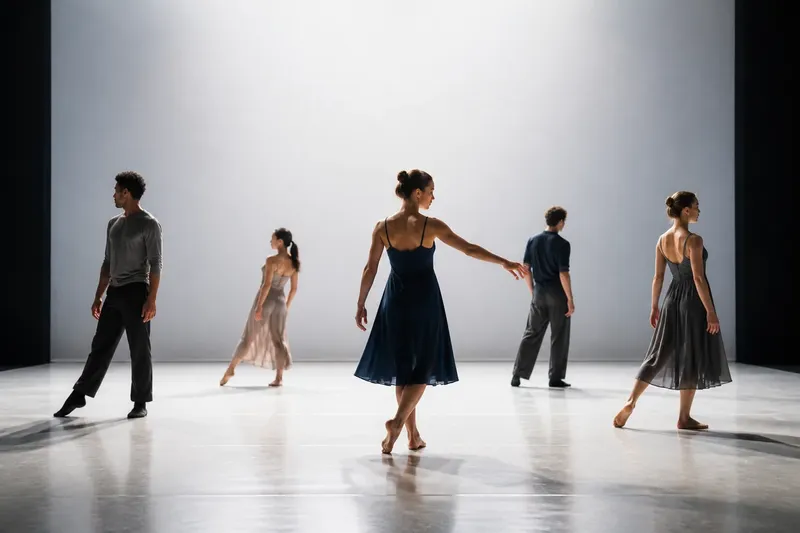
At your first dance performance, watch where the dancers leave room for one another. A first dance performance becomes easier to follow when you notice how performers share, divide and change the stage, rather than trying to name every movement as it happens.
This approach works for ballet, contemporary dance, street dance and many other forms. You do not need specialist vocabulary or a seat with a perfect view. Choose one spatial relationship at a time, then let the performance show how it shifts.
Before the dance begins, choose a place to look
Once you are seated, take in the whole stage rather than fixing your gaze on the centre. Notice the visible boundaries: the back wall, the wings, the floor, any platforms or steps, and the space closest to the audience. In a studio performance, the playing area may be marked by tape or simply framed by the room.
Look for the arrangement before the movement starts. Are the dancers gathered in a cluster, spread evenly, or lined up? Does one performer stand apart? These are observations, not clues with a single correct answer. They give you a starting picture that you can compare with what follows.
Settle on a viewing position that lets you see as much of the stage as possible without straining. If you are choosing seats, a central view often makes formations easier to read; a side view can make entrances, exits and depth more noticeable. Either can be rewarding. Keep your eyes free to move rather than trying to follow a particular dancer from the outset.
As the movement starts, follow the gaps
Begin by watching the empty areas. A gap between two dancers may widen as they move apart, close as they approach, or shift when someone crosses through it. Notice whether the opening feels like a passage, a boundary or a space that nobody claims. You do not have to decide what it means.
Then watch how the dancers relate to the edge of the stage. A performer who stays near the back may seem visually distant from someone moving at the front. If one dancer travels towards a wing while another remains still, the distance between them becomes part of the composition. The audience can register that change even without seeing a face or gesture clearly.
Try not to scan every part of the stage at once. Choose one pair, one cluster or one open area, and let your attention widen when the pattern changes. In a crowded passage, look at the overall direction of movement; in a quiet one, notice where the space settles.
When formations change, ask who gets room
A group can occupy space in different ways. Dancers may stand shoulder to shoulder, form a curve, make a corridor, or scatter across the floor. Watch who has room to move within each arrangement and who appears held in place by the group’s shape. Then see whether that balance changes.
Notice whether the dancers move together or take turns. When a group travels as one, the shared route can make the stage seem smaller or more unified. When one person moves against the group’s direction, the contrast becomes visible without needing a story to explain it.
Pay attention to spacing as well as direction. Performers can travel towards the same point but maintain a clear distance from one another; they can also crowd together while remaining almost still. The amount of room between bodies changes the picture and can alter the mood. A close formation may feel concentrated, while a broad spread may make the stage feel exposed.
Watch the centre change hands
The centre of the stage often attracts attention, but it is not automatically the most important place. Notice who occupies it, who approaches it, and who yields it. If a dancer moves from the edge into the middle, see whether others make room, follow, or continue on their own paths.
Also watch for a centre that shifts. A diagonal line or a moving cluster can pull your eye away from the literal middle. When performers redirect their bodies or travel towards a new area, the visual focus can move with them. Following that shift is more useful than deciding in advance that the lead dancer must always be the main subject.
Imagine a small group begins in a tight cluster at the back, then one dancer crosses to the front while the others open into a wide arc. You might notice the crossing performer gaining space, while the arc makes the empty centre visible. If the group then closes around that opening, the observable change is clear: the stage moves from separation to enclosure. You can hold that sequence in mind without attaching a fixed story to it.
As dancers travel, notice how the route is made
Track a path rather than a catalogue of steps. A dancer might move in a straight line, trace a curve, turn back, or circle another performer. Watch where the route begins and ends, and whether the performer crosses an empty area or skirts around it.
Entrances and exits can change the balance of the whole stage. When someone enters, notice whether the existing group welcomes, ignores or makes room for them through its spacing. When a performer leaves, see whether the remaining dancers close the gap or preserve it. The absence itself can become part of the arrangement.
Keep perspective in mind. A dancer near the audience may appear much larger than one at the back, even if both are equally prominent in the choreography. Rather than treating depth as a ranking, follow how the performers use front, middle and back areas. A repeated crossing between these zones can give the movement a sense of approach, withdrawal or circulation.
When should you change what you watch?
Should you follow one dancer or the whole group?
Start with the whole group when the stage is busy, then choose one dancer if a clear route or separation emerges. Return to the full formation when the group changes shape, so you do not miss how one person’s movement affects the others.
What if the choreography feels too fast to follow?
Let individual steps go and watch broad patterns: a cluster breaking apart, a line crossing the stage, or performers moving in opposing directions. These changes remain visible even when the detail passes too quickly to name.
Where should you look during a solo?
Watch the soloist’s relationship to the surrounding space, not only the movement of their limbs. Notice whether they fill the stage, stay within a small area or repeatedly return to one point.
What if the movement seems abstract?
Stay with observable choices such as distance, direction, level and timing. You can describe what changed without deciding what the dance represents, and your response can remain open while the performance continues.
After a shift, hold onto one clear observation
When a formation changes noticeably, pause your search for the next detail and register what just happened. You might note that a line became a circle, that a dancer crossed an open centre, or that the group left one performer alone at the edge. A simple internal sentence is enough: “They moved apart, then one crossed between them.”
This brief pause helps you link one arrangement to the next. Dance often makes its shape through transitions rather than still poses, so ask what the change did to the room: did it open a route, block one, draw attention to an empty patch, or bring the group closer?
If you lose track of the movement, return to the broadest visible pattern. Look for the largest cluster, the main direction of travel, or the most striking empty area. You can rejoin the performance from there. Missing a passage does not prevent you from noticing the next change.
Use the journey out to keep the viewing plan simple
As the performance ends, recall one change in the use of space rather than trying to recount every section. Perhaps the dancers began far apart and ended in close formation, or the stage’s centre remained empty while movement gathered at the sides. Keep the description tied to what you saw before adding any interpretation.
If you want to discuss the work afterwards, ask someone else what spatial change they noticed. Their attention may have settled on a different route, edge or grouping, which can broaden your view without turning the conversation into a test of who understood the dance correctly.
For your next first dance performance, carry one question into the room: who has space, and what changes when they move? That question gives you a practical thread to follow, while leaving the dancers’ choices—and your own response—room to remain complex.